Non-surgical · Discreet · Personalised

Helping people find a more manageable way forward.

A single, calm place to explore non-surgical support for bladder control, pelvic floor weakness, bowel concerns and intimate health — all brought together under one thoughtful, respectful approach.

EMS Treatment Urinary Incontinence Stress Incontinence Mixed Incontinence Overactive Bladder Stool Incontinence Erectile Dysfunction Support
A thoughtful starting point

Personal concerns that so often go unspoken.

Illustration of a person sitting calmly, surrounded by abstract shapes representing different concerns

These issues tend to start quietly. A small leak. A sudden urge. A slight drop in confidence. Over time, they begin to shape daily life in ways that can feel difficult to explain to anyone else.

For many people, the reality of bladder control concerns, bowel control concerns, pelvic floor weakness or intimate health issues such as erectile dysfunction begins with something that feels small. Over time, those symptoms start to shape clothing choices, how far a person walks, how long they stay out, how they sleep and how comfortable they feel in their own body. None of this is easy to talk about. People carry these concerns for far longer than they should — not because the problem itself is minor, but because speaking openly about something so personal feels difficult.

Incontinence Direct aims to take some of the weight out of that first step. The service is built for men and women who want support that feels discreet, practical and genuinely human. A range of non-invasive care options, including Incontinence Direct Frequent Bathroom Trips Solution, is brought together under one calm, considered approach, so people can look at their options without feeling overwhelmed. There is no pressure and no complexity — only care that is grounded in comfort, privacy and the realities of daily life.

What matters most for many visitors is the feeling of being understood. They are not looking for dramatic promises. They are looking for a clear sense of where things go from here, and for their symptoms to be taken seriously with a process that is handled properly. That is the tone that runs through every part of this page, from the first word to the last.

The concerns covered on this page are often connected in real life. One person may experience urinary leakage alongside pelvic floor weakness. Another may deal with urgency, frequency or stress incontinence. A third may be looking for help with bowel control. Someone else may be quietly considering support with erectile dysfunction. The concerns look different on the surface, yet they share something important in common: each one has the capacity to affect confidence, routine and peace of mind.


01 Core treatment

EMS (Electromagnetic Seat) Treatment

Illustration of a person sitting on a chair with abstract waves representing electromagnetic energy supporting the pelvic area

The name sounds technical, but the experience is a great deal simpler than what the technology suggests — calm, private and thoughtfully designed for everyday life.

At a glance
  • Non-surgical and non-invasive
  • No undressing required
  • No downtime afterwards
  • Designed for comfort and discretion

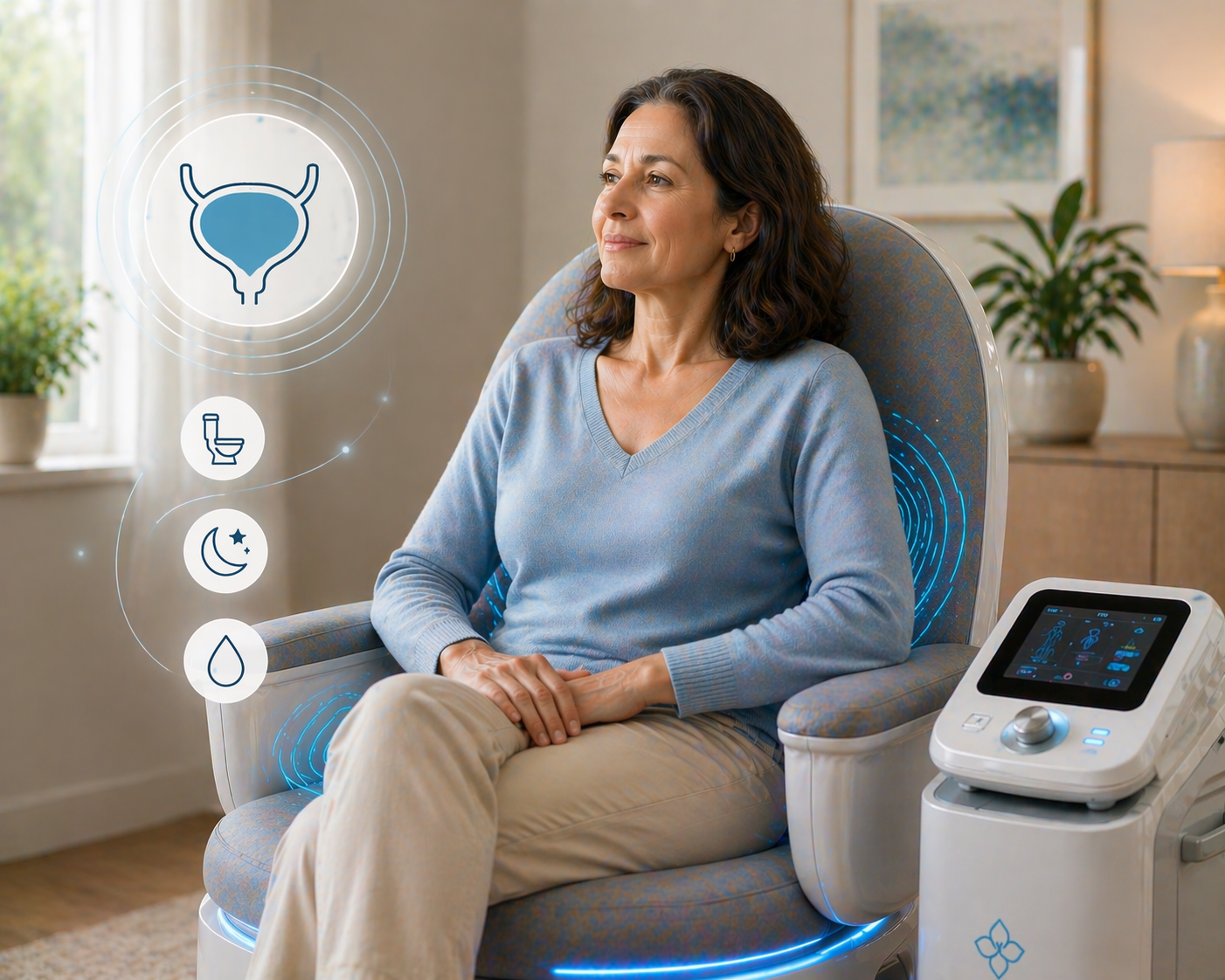
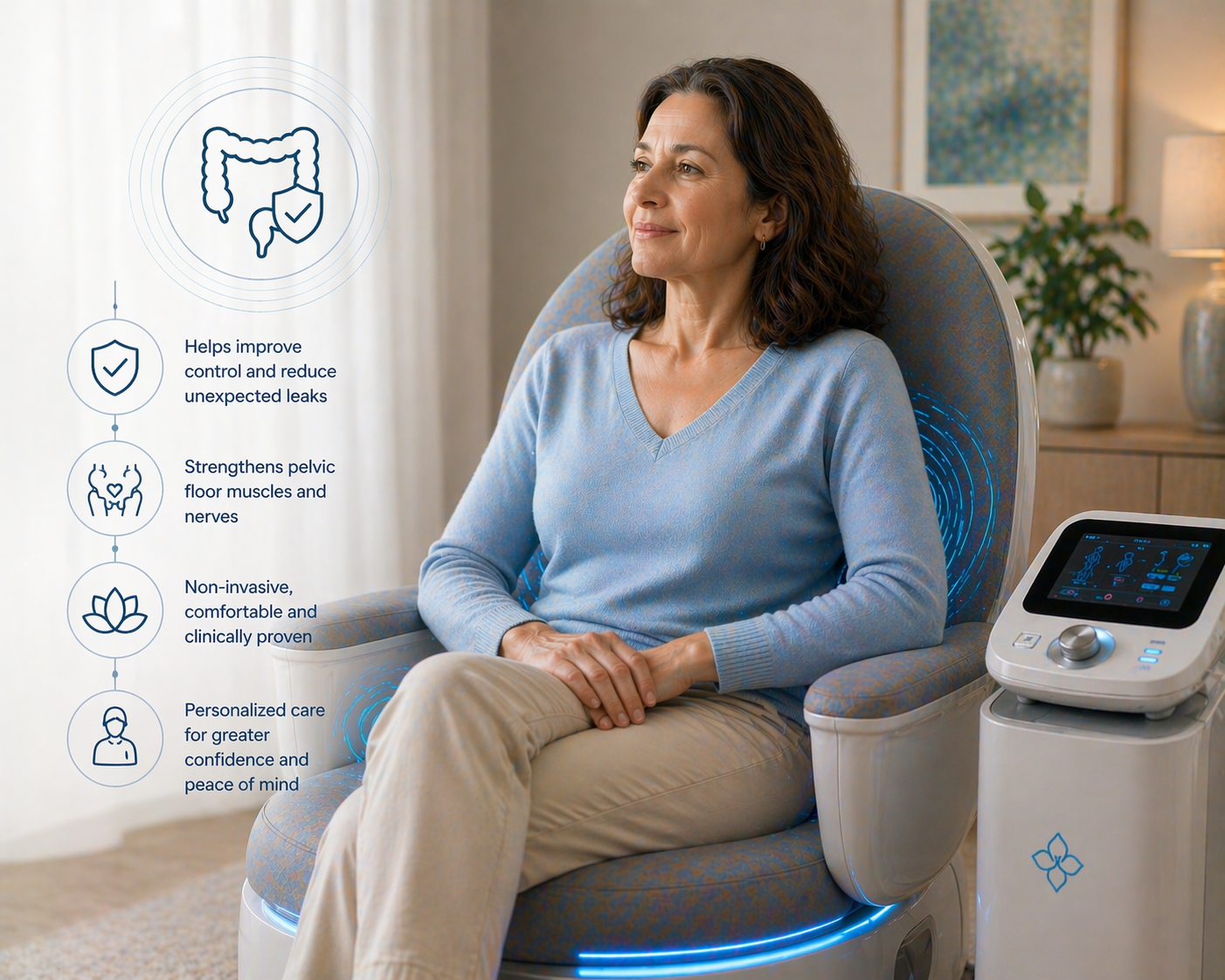
EMS treatment — or Electromagnetic Seat treatment — is a non-surgical, non-invasive way to support the muscles of the pelvic floor. Incontinence Direct pelvic floor therapy explores that support in more detail. These muscles play a central role in bladder and bowel control. When they become weaker or less responsive, symptoms such as leakage, urgency and poor control can begin to interfere with everyday life in small but persistent ways. EMS treatment offers those muscles a steady, considered form of support.

The technology works by using electromagnetic energy to stimulate the pelvic floor muscles gently. The stimulation helps those muscles contract and strengthen, which over time helps them respond more effectively. For people hoping to improve bladder or bowel control without surgery — and without a lengthy recovery — that difference can be meaningful.

One of the most valued aspects of EMS treatment is how simple a session actually feels. There is no need to undress. The person remains fully clothed throughout. There is nothing invasive to prepare for. There is no recovery period afterwards, which means people can return to their ordinary day straight away. That practical simplicity is often what makes it possible to fit treatment into a busy life.

This matters because many people delay treatment for years, quietly hoping that symptoms will improve on their own. Often they do not. People often assume treatment will be awkward, disruptive or unpleasant, and that assumption alone is enough to put it off. EMS treatment removes many of those barriers, offering a non-intimidating way to begin.

The treatment itself should be described reassuringly rather than with a clinical edge. Most people do not want a technical lecture — they want to know what it is and what to expect. EMS treatment is a discreet, non-invasive way to support pelvic floor strength and improve control, so that symptoms have less influence over daily life.

For someone who has been managing symptoms silently, this kind of option can feel genuinely freeing. It offers something practical to work toward without pushing anyone into something larger than they are ready for. It fits the realities of everyday life, which is exactly what most people are looking for when they finally decide to explore support.

02 Intimate health

Erectile Dysfunction Support

Illustration of a person sitting calmly with abstract shapes representing confidence, relationships and wellbeing surrounding them

A respectful, non-surgical pathway for a concern that is rarely spoken about — one that takes in more than physical function alone.

Shaped around
  • Privacy and quiet conversation
  • Confidence, mood and relationships
  • Non-surgical, calm approach
  • Realistic, honest guidance

Erectile dysfunction is a deeply personal concern, and it involves more than physical function alone. Confidence, relationships, mood and self-image can all be quietly affected. Incontinence Direct Urge Incontinence Treatment is another example of the kind of discreet support people often look for. Many men avoid discussing it because they feel embarrassed, or because they assume they should simply handle it on their own. That silence has a way of making the concern feel bigger than it needs to be.

Incontinence Direct approaches erectile dysfunction support with the respect and honesty the subject deserves. The tone is calm and mature. The experience is private. People can move through the process at their own pace, without feeling judged or rushed, and without needing to explain more than they want to.

The service is offered as a non-surgical option. This matters because many people are ready to explore support, yet they are not prepared to step straight into anything more invasive. For someone who has been avoiding help for a long time, the idea that something non-surgical exists can feel far more accessible and far less intimidating.

There is no drama in how this concern is handled. Honesty matters here. People want the service to show empathy rather than make over-stated promises. They want to feel they are speaking with thoughtful, grown-up professionals — not being sold a dream. That tone is what helps trust take root.

Support for erectile dysfunction is placed here as part of a wider conversation around wellbeing. It is not defined by a single function. It is about confidence, ease in everyday life and feeling more like oneself again. When the subject is handled with care, people tend to feel far more ready to step forward.

For many men, relief can come simply from finding a setting where the topic can be discussed without shame. That is why this area of the service is designed to feel spacious, steady and reassuring. The message is simple: support exists for them, and they do not have to carry the concern alone.

03 Bladder control

Urinary Incontinence Treatment

Illustration of a person walking confidently with abstract shapes representing freedom, confidence and support surrounding them

Urinary incontinence comes in many forms. Even mild versions can quietly shape the way people live, travel and spend time with others.

Supports
  • Better bladder control
  • Reduced worry about urgency
  • Greater day-to-day confidence
  • Less unpredictability

Urinary incontinence shows up across a wide spectrum. For some, it may appear as a small amount of leakage during certain movements, coughing, laughing or exercise. For others, it may involve more frequent thoughts about bladder control, increased urgency, or a quiet habit of planning each day around easy toilet access. Even mild symptoms can have a bigger impact on ordinary life than might first appear.

It often starts with small adjustments. Choosing certain clothes. Avoiding long trips. Timing outings carefully. Sitting closer to the exit. Keeping a quiet mental map of nearby bathrooms. Habits like these can seem minor, but they gradually affect confidence and freedom over time.

Incontinence Direct offers a practical and non-invasive approach to urinary incontinence treatment that helps support bladder control. The aim is to soften that sense of worry or unpredictability so that daily life begins to feel less governed by symptoms. For someone who has been quietly managing this concern for a long time, that shift can make a genuine difference.

Information on this topic should be delivered in plain, everyday language. It should not be weighed down with jargon or heavy medical terminology. People reading this want to understand what is happening in their body and what forms of support exist. They do not need a lecture. They need clear, respectful information.

There is also an emotional side to urinary incontinence that deserves attention. It is not only a physical inconvenience. It can affect confidence, spontaneity and quality of life. People may feel less comfortable at work, in social settings, while travelling, or even at home. Treatment is offered as a way to lift both the physical and the emotional weight of the concern.

The tone here matters enormously. The page should feel composed and capable, reassuring the reader that urinary incontinence is a common and very understandable concern. It does not need to sound loud or clinical — it needs to sound calm, capable and supportive.

04 Pressure-related leakage

Stress Incontinence Treatment

Illustration of a person sitting calmly with abstract shapes representing pressure, support and confidence surrounding them

One of the most common forms of bladder leakage. It arrives in ordinary moments — coughing, sneezing, lifting, laughing — and can quietly narrow the world.

Often shows up as
  • Leaks during coughing or sneezing
  • Leaks during laughter or exercise
  • Unease with heavy lifting
  • Subtle changes in confidence

Stress incontinence is one of the most common forms of bladder leakage. It tends to occur when pressure is placed on the bladder — during a cough, a sneeze, a burst of laughter, heavy lifting or exercise. Many people find it particularly frustrating because it can appear at moments that are difficult to plan for or avoid.

At first, people often dismiss it as something small. A tiny leak — nothing serious, they tell themselves. They adjust their clothing. They become a little more cautious. Over time, though, that low-level concern can begin to affect confidence and movement. People may start avoiding certain activities or worrying about being caught unprepared. The world can quietly shrink in ways it never needed to.

Because this kind of leakage tends to occur when internal pressure rises, stress incontinence treatment is focused on supporting the muscles that hold up under that pressure. When those muscles are strengthened and encouraged to respond more effectively, everyday movements feel far more manageable than before.

The language used around this concern should remain friendly and approachable. It does not need to sound technical to be meaningful. Anyone reading about this subject knows exactly what stress incontinence feels like — what they really need is reassurance that support exists and that things can improve.

What helps most here is practical reassurance. Stress incontinence is a genuine concern, but it does not need to define how a person lives their life. Support can help people feel more protected, more prepared, and less restricted by the quiet fear of leakage during everyday activities.

This area of care also gently normalises the subject. Stress incontinence is extremely common, yet many people feel isolated by it. Speaking about it plainly and without shame helps ease that sense of isolation, which is one of the reasons a thoughtful service page can do so much quiet good.

05 Combined concerns

Mixed Incontinence Treatment

Illustration of a person sitting calmly with abstract shapes representing different symptoms overlapping around them

When more than one type of symptom overlaps, managing day-to-day life becomes harder to predict. Support here is built around the full picture.

May include
  • Leakage during movement
  • Sudden urges and urgency
  • Unpredictable bladder pressure
  • Overlapping patterns day to day

Mixed incontinence can be particularly frustrating because it may involve more than one type of symptom at the same time. Someone might leak during movement while also dealing with urgency or sudden bladder pressure. That combination can make the concern feel harder to pin down and less predictable than any single form would be on its own.

For many people, the unpredictability is the hardest part to live with. They may never feel entirely sure how their body will behave from one day to the next. That uncertainty makes even simple or routine activities feel a little more complicated than they should be.

Incontinence Direct approaches mixed incontinence with the understanding that it is not simply a single untreated concern. It often calls for a more thoughtful, more individual approach. The aim is to develop a clearer picture of the full range of symptoms a person experiences, and to support them in a way that reflects their real experience rather than a textbook version of it.

Everything about this description is kept simple and human. There is no need to treat mixed incontinence with excessive gravity or rely on medical jargon. The goal is to describe it clearly enough that a reader can recognise whether any of this feels familiar to them.

Personalisation matters especially here, because every individual with mixed incontinence will experience it differently. For some, stress-related leakage is the more obvious concern. For others, urgency dominates. A few experience both in equal measure. A thoughtful service recognises that balance and adapts care accordingly.

The underlying reassurance in this area of support is simple. Even when symptoms feel messy or harder to understand, the experience can still be heard, taken seriously and addressed with care. When someone feels that sense of acknowledgement, they are far more willing to continue exploring support rather than turning away from it again.

06 Bladder urgency

Overactive Bladder Treatment

Illustration of a person sitting calmly with abstract shapes representing pressure, urgency and support surrounding them

When the bladder feels like it is running the day, the pressure never really goes away. Support is focused on restoring a steadier rhythm.

Can affect
  • Sleep and rest
  • Travel and social activities
  • Focus during the day
  • Overall sense of ease

Overactive bladder takes a steady toll on daily life. It often means multiple trips to the bathroom, sudden urges that feel difficult to control, and a background sense that bladder activity is dictating the day. Even when a person tries to ignore the pressure, it tends to linger just out of view.

The concern can affect sleep, travel, work and the rest of a normal day. People may begin to feel that they need to know where a bathroom is at all times. Planning life around that level of uncertainty quickly becomes exhausting, and it can quietly drain energy that should be available for the things that matter.

The aim of overactive bladder treatment is to bring back a greater sense of control. It is about softening the pressure and the pace that can make ordinary life harder to enjoy. Just as importantly, it is about helping the person feel less defined by the condition and more in charge of their own routines.

The tone used when describing this kind of concern must never be alarming. Someone reading about overactive bladder is likely already feeling worn down by it, and the content should avoid adding pressure. Instead, it should offer calm clarity and a sense that a clear path forward exists.

Overactive bladder is one of those concerns that many people put up with for far too long, sometimes assuming it is simply a normal part of getting older. It deserves a proper, thoughtful response. With the right support in place, daily life can feel more predictable, easier to navigate and less dominated by bathroom planning.

This section of the service is built to offer guidance without exaggeration. Support exists. The concern is taken seriously. Treatment is geared toward steady, dignified progress — one calm step at a time — rather than quick promises or oversimplified answers.

07 Bowel control

Stool Incontinence Treatment

Illustration of a person sitting calmly with abstract shapes representing privacy, support and understanding surrounding them

One of the most private of all health concerns — and one that deserves to be met with steady respect and genuine understanding.

Built on
  • Respect and non-judgement
  • Careful, private care
  • Steady, thoughtful support
  • Meaningful, real improvement

Stool incontinence is one of the most private health concerns a person can face. It can feel intensely personal, and for that reason many people avoid discussing it at all. Some feel embarrassed. Some feel shame, even though what they are experiencing is a genuine health concern that deserves to be addressed.

The tone of any information on this subject must do the careful work the topic requires. It should be respectful, non-judgemental and warm. There should be no hint of awkwardness or shame in the writing, because this needs to feel like a safe area where the subject can be raised openly.

Stool incontinence can quietly erode confidence, social life and peace of mind. It may cause people to hesitate about leaving home or being away from familiar surroundings for long periods. It can create anxiety around routine, travel or exercise. These are difficult things to describe, but they are real, and they should never feel like something anyone has to carry in silence.

Incontinence Direct offers a private way to seek help for this concern. It is designed to let people know they are not alone and that their symptoms deserve thoughtful, professional attention. That simple acknowledgement alone can go a long way toward easing the weight of the experience.

This area of treatment is focused on support, privacy and meaningful improvement. Every individual's experience will differ, of course, but the aim is to help ease ongoing symptoms and restore a sense of steadiness to everyday life.

This is a subject that should never be rushed. It calls for patience, space and careful handling. A good service page can do exactly that — by being warm, direct and steady, it lets the reader know that they can ask for help here without judgement, and that the support they receive will be shaped with care.

Why people choose Incontinence Direct

Practical reasons. Emotional reasons. Human reasons.

People come to this service for a range of reasons — and every one of them is met with the same calm, considered approach.

01

Privacy above all

These concerns are deeply personal. People want to feel that their dignity is protected throughout the process, and the service is designed to keep that front of mind from the very beginning.

02

Everyday convenience

Treatment needs to fit around real life — work, family, travel and the many commitments of every week. No downtime and flexible access make support something that can be kept, not postponed.

03

A non-surgical route

Surgery is not the right choice for everyone. Having a thoughtful, non-invasive first step available means people can take action without having to commit to anything larger than is necessary.

04

Care shaped to the person

Treatment is never a cookie-cutter approach. Plans are tailored to the individual, their symptoms and their lifestyle — which makes the whole experience feel more personal, respectful and trustworthy.

05

A genuinely human tone

How something is said matters as much as what is said. The service prioritises empathy, quiet listening and a steady voice — so people feel heard rather than processed.

06

Support for men and women

Incontinence is not defined by one group or one stage of life. The service is shaped equally around the needs of men and women, across a range of symptoms and experiences.

The common thread

Care that feels dignified, practical and realistic.

People come to Incontinence Direct for a mix of practical and emotional reasons. It is never a single-purpose service, and it does not try to be. What it does, quietly and consistently, is make the whole experience of seeking support feel less overwhelming. That alone is reason enough for many people to step forward.

Privacy sits at the centre of everything. These concerns are personal, and many people do not want the process to feel exposed in any way. They want to feel that their dignity is being looked after at every step — and the service is built around that need.

Convenience matters just as much. Treatment is designed so it can be kept without disruption to daily life. Accessibility, flexible options and a straightforward process mean that support can happen alongside normal commitments rather than clashing with them.

Because no surgery is involved, many people find the service far more approachable. Not every concern requires a surgical step, and the option to begin with something calmer, less invasive and easier to accommodate makes support feel far less intimidating.

Access that adapts

Home-based or clinic-based — whichever fits best.

Illustration of a person sitting calmly with abstract shapes representing different access options surrounding them

Accessibility is often the quiet difference between putting off treatment and actually beginning. Two clear options make that step easier to take.

Clinic-based

A structured, professional environment.

Clinic-based treatment offers care within a clear, considered setting — a straightforward routine and a calm, clinical pathway that many people find reassuring. For those who prefer definition and structure, this option can feel especially comfortable.

Home-based

A familiar, private space.

Home-based care can feel calmer, more private, and simpler to organise around a busy schedule. For people already navigating a sensitive concern, staying in a familiar setting can make the whole process feel a great deal less overwhelming — and that matters.

The broader point

Flexibility that respects how people actually live.

Accessibility matters. It is often the quiet line between putting off treatment and finally taking that first step. Incontinence Direct understands that the way support is delivered has to work around the person, not the other way round. That is the principle that shapes both clinic and home-based options.

For some, the clinic is the right answer. It offers a structured, professional setting and a reassuring sense of purpose. For others, home-based care is what makes treatment realistic — quieter, more private, and built around the comfort of familiar surroundings. Having both options reflects a considered service that recognises different preferences and comfort levels.

The overall message is flexibility. People should not have to fit themselves into a system that does not suit their life. A service that bends toward the individual, rather than demanding the opposite, is far more likely to feel trustworthy and supportive — and far more likely to be kept with over time.

A tailored treatment approach

No two people arrive with the same story.

Some are noticing symptoms for the first time. Others have lived with them for years. A thoughtful service responds to both — without forcing anyone into a template.

Some people arrive with symptoms that have just started. Others have been living with theirs for years. Some have one concern they want to address. Others are managing several at the same time. A considered service has to reflect all of that — not one version of it.

Incontinence Direct is built around personalised treatment plans. Rather than applying the same solution to every person who arrives, the focus is on what works for the individual. Meaningful care begins there.

A tailored plan makes the entire experience feel more supportive. It allows the initial consultation to genuinely shape the treatment, rather than being treated as a formality. That means the person feels heard and respected, rather than simply processed. Small details like this have a way of shaping how comfortable someone feels moving forward.

This kind of attention is particularly valuable in cases of overlapping symptoms. One person may be managing stress incontinence alongside urgency. Another may be balancing pelvic floor weakness with bowel control concerns. A tailored approach acknowledges the reality of both experiences and responds accordingly, rather than over-simplifying the picture.

Personalisation, in other words, is not an optional extra. It is central to what makes care feel effective, respectful and relevant. Before any recommendation is made, people want to know that their situation matters enough to be understood properly — and it is that simple idea that quietly builds trust.

When someone feels heard, they are far more likely to feel ready to take the next step. That moment of feeling understood is often where a longer journey of steady, meaningful progress begins.

Emotional reassurance

Behind every symptom is a person — and every person deserves to feel seen.

Illustration of a person sitting calmly with abstract shapes representing emotional reassurance, support and understanding surrounding them

It would be easy to treat these concerns as purely clinical. On the surface, a symptom seems logical. Beneath the surface, it is often tangled up with confidence, self-esteem and self-image. That is an important thing to recognise.

Bladder leakage can make someone feel less spontaneous. Overactive bladder can make a person feel perpetually interrupted by their own body. Stool incontinence can feel intensely private. Erectile dysfunction can bring frustration, anxiety, or a quiet tendency to withdraw. All of these are entirely human responses to very human concerns.

A thoughtful service page acknowledges that emotional layer as much as the physical one. It makes room for it. It speaks gently. It avoids heavy language or judgement. It quietly reassures the reader that there is nothing unusual about the way they may be feeling, and that these are not things to carry alone.

That emotional reassurance runs through every part of this page. It shows up in how EMS treatment is described. It is there in how more intimate health concerns are handled. It sits at the centre of the closing thoughts and the FAQ. The page as a whole is written to repeat the same calm message in different ways: you are not alone, and support is built for you.

That kind of rhythm is quietly reassuring for someone reading late at night, or someone weighing up options before making a decision. It turns uncertainty into something closer to quiet confidence — and sometimes, that is exactly what a person needs to feel ready for the next step.

Common questions

Clear, honest answers to the things people naturally ask.

What is Incontinence Direct?
Incontinence Direct is a professional service offering non-surgical support for a range of incontinence-related concerns and intimate health issues. It is designed for men and women who want a discreet, practical way to receive thoughtful treatment.
What treatments are covered on this page?
This page covers EMS treatment, erectile dysfunction support, urinary incontinence treatment, stress incontinence treatment, mixed incontinence treatment, overactive bladder treatment and stool incontinence treatment.
Is the treatment invasive?
No. EMS treatment is non-invasive and non-surgical. It is designed to feel calm, straightforward and easy to move through.
Do I need to undress for EMS?
No. The treatment is carried out fully clothed, which helps the experience feel far more private and comfortable from the start.
Is there any recovery time?
No. There is no recovery time between sessions. People can return to their normal activities straight afterwards, which is one of the reasons the treatment fits so easily into everyday life.
Is this service available for men and women?
Yes. The service is built for both men and women, with support across a range of different concerns and experiences.
Are treatments available at home?
Where available, yes. Incontinence Direct offers both clinic-based and home-based support for incontinence concerns, so that care can fit naturally around a person's life.
Are treatment plans the same for everyone?
No. Every plan is personalised, shaped around how an individual presents and what they are actually experiencing. There is no one-size-fits-all approach.
How does the process usually begin?
The usual first step is a consultation. This gives the service time to understand a person's symptoms and discuss the kind of support that might suit them best, before anything further is recommended.
A calm, unified place to begin

Many related concerns — one quiet, thoughtful space.

Incontinence Direct brings a number of connected areas of support together in one considered, straightforward setting. That matters because these concerns tend to sit close to one another in real life. When they arise, they can affect confidence, comfort, movement, routine and peace of mind in ways that are both personal and widely shared — and they deserve thoughtful care.

The value of this service is not only in the treatments themselves. It is in how they are presented. Non-surgical. Discreet. Tailored. Accessible. Human. How safe and comfortable the experience feels matters every bit as much as the clinical substance of the support — and arguably, it matters even more for someone seeking help for the first time.

For some, this page will be the first step after a long period of uncertainty. For others, it will be the first time they have seen these connected concerns gathered into one cohesive service. Either way, the message remains the same steady reassurance. Support is available. It can be delivered privately and practically. It can be shaped around the person, rather than asking the person to shape themselves around the treatment.

Discreet

Private from the first quiet conversation through every step that follows.

Tailored

Every plan designed around the person, never a generic template applied sideways.

Accessible

Clinic-based or home-based — support that meets people where they already live.